高性能传热解决方案,满足您的行业需求
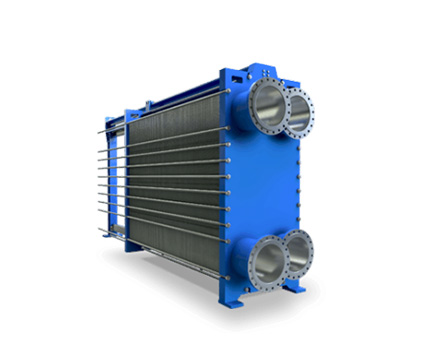
产品详情
Xinmao Plate Heat Exchanger will tell you at 16:00 how domestic plate heat exchangers have embarked on the path of counterattack,
1. High heat transfer coefficient: Due to the inversion of different corrugated plates, complex flow channels are formed, allowing the fluid to rotate in three dimensions in the flow channels between the corrugated plates. Turbulence can be generated at lower Reynolds numbers (generally Re=50~200), resulting in a high heat transfer coefficient. Its heat transfer coefficient is between 3000~4500 kcal/㎡·° C · h, which is generally considered to be about 3~5 times higher than that of shell and tube type.
2. Large logarithmic mean temperature difference and small end temperature difference: In a shell and tube heat exchanger, two fluids flow separately in the tube side and shell side, resulting in overall cross flow. The logarithmic mean temperature difference correction coefficient is small, while plate heat exchangers are mostly parallel or counter current flow modes, with a correction coefficient usually around 0.95. In addition, the flow of cold and hot fluids in plate heat exchangers is parallel to the heat exchange surface and there is no bypass flow, resulting in a small end temperature difference for plate heat exchangers and water heat transfer below 1 ℃, while shell and tube heat exchangers generally have a correction coefficient of 5 ℃.
3. Small footprint: Plate heat exchangers have tightly arranged plates and compact structures, with a heat transfer area per unit volume that is 2-5 times that of shell and tube heat exchangers. Unlike shell and tube heat exchangers, which require reserved maintenance areas for extracting tube bundles, plate heat exchangers occupy less space and space, thus achieving the same heat transfer. Plate heat exchangers occupy an area of about 1/5 to 1/8 that of shell and tube heat exchangers.
4. Easy to change the heat exchange area or process combination: Plate heat exchanger plates are independent components that can be added or removed according to requirements, with various forms. As long as a few plates are added or removed, the purpose of increasing or reducing the heat exchange area can be achieved; By changing the arrangement of the plates or replacing a few plates, the required process combination can be achieved, which can be applied to various different process requirements. The heat transfer area of shell and tube heat exchangers is almost impossible to increase.
5. Lightweight: The plate thickness of plate heat exchangers is only 0.4~0.8mm, while the thickness of the heat exchange tubes of shell and tube heat exchangers is 2.0~2.5mm. The shell of shell and tube heat exchangers is much heavier than the frame of plate heat exchangers, and plate heat exchangers are generally only about 1/5 of the weight of shell and tube heat exchangers.
6. Low price: Using the same materials and with the same heat exchange area, plate heat exchangers are about 40% to 60% cheaper than shell and tube heat exchangers.
7. Easy to produce: The heat transfer plates of plate heat exchangers are processed by stamping, with high standardization and can be mass-produced. Shell and tube heat exchangers are generally handmade.
8. Easy to clean: The frame plate heat exchanger only needs to loosen the clamping bolts to loosen the plate bundle and remove the plates for mechanical cleaning, which is very convenient for heat exchange processes that require frequent cleaning of equipment.
9. Low heat loss: Plate heat exchangers only expose the outer shell of the heat transfer plate to the atmosphere, so the heat dissipation loss can be ignored and no insulation measures are required. And shell and tube heat exchangers have high heat loss and require insulation layers.
10. Small capacity: about 10% to 20% of the shell and tube heat exchanger.
11. Large pressure loss per unit length: Due to the small gap between the heat transfer surfaces and the presence of irregularities on the heat transfer surfaces, the pressure loss is greater than that of traditional smooth pipes.
12. Not easy to scale: Due to sufficient internal turbulence, it is not easy to scale, and the scaling coefficient is only 1/3~1/10 of that of shell and tube heat exchangers.
13. The working pressure should not be too high, as leakage may occur: Plate heat exchangers are sealed with gaskets, and the medium temperature should be below 250 ℃, otherwise leakage may occur.
14. Easy to clog: Due to the narrow channels between the plates, usually only 2-5mm, it is easy to clog the channels between the plates when the heat exchange medium contains larger particles or fibrous substances.
15. Long service life: Plate heat exchangers are made of stainless steel or titanium alloy plates, which can withstand various corrosive media. The rubber pads can be replaced at will and are easy to disassemble and repair.
16. No liquid leakage: The sealing groove of the plate heat exchanger is equipped with a drainage channel, so that various media will not collude. Even if there is a leakage, the media will always be discharged outward.